Saturday, September 10, 2005
Please Pitch In
Colleen Mondor of Bookslut has put out a call for donations -- via an Amazon wishlist -- for books and games for evacuee children currently sheltered by Parkview Baptist in Baton Rouge. All you have to do is pick some books or games, enter your amazon info, and you're good to go -- and you'll doing be some good as well.
Also: in an e-mail this morning Colleen had a great suggestion, which is for reviewers, bookstores, or publishers with extra ARCs of children's books laying around to donate them for these kids. If you got a pile of ARCs not doing anything -- and if you're at all involved in the book biz, I know you do -- drop me a line at collinslibrary AT aol.com and I'll forward your email on to Colleen...
Also: in an e-mail this morning Colleen had a great suggestion, which is for reviewers, bookstores, or publishers with extra ARCs of children's books laying around to donate them for these kids. If you got a pile of ARCs not doing anything -- and if you're at all involved in the book biz, I know you do -- drop me a line at collinslibrary AT aol.com and I'll forward your email on to Colleen...


Saturday, January 02, 2010
Omniscience
I'm in Slate this week with an article and slide show remembering the giddy futurism of Omni magazine:

The piece began after I found a stash at a junk store, and was hit by a shock of recognition of a 1979 cover -- I actually remembered getting that issue as a kid. And inside the issues, the ads of long-lost firms -- DAK, Fidelity Chess, Infocom games, Commodore 64! -- were as weirdly evocative as the articles. Leafing through pages I last read 25 to 30 years ago, I found myself remembering them. A lot of them, in fact. I've become so used to the ephemeral nature of magazines that I've forgotten how some reading experiences -- especially at the age of 10 -- can still deeply, subtly imprint themselves.
Among the many riches I found in a junk-shop stash of Omnis -- (Yonkers spaceport! A 1984 account of telecommuting! An Italian atomic bomb!) -- I also came across this astounding ad from the final days in 1995, long after I and just about everyone else had stopped reading. No matter how hard up times may be for science magazines today, just remember: nobody's asking their editorial assistants to staff a 900-number.


The piece began after I found a stash at a junk store, and was hit by a shock of recognition of a 1979 cover -- I actually remembered getting that issue as a kid. And inside the issues, the ads of long-lost firms -- DAK, Fidelity Chess, Infocom games, Commodore 64! -- were as weirdly evocative as the articles. Leafing through pages I last read 25 to 30 years ago, I found myself remembering them. A lot of them, in fact. I've become so used to the ephemeral nature of magazines that I've forgotten how some reading experiences -- especially at the age of 10 -- can still deeply, subtly imprint themselves.
Among the many riches I found in a junk-shop stash of Omnis -- (Yonkers spaceport! A 1984 account of telecommuting! An Italian atomic bomb!) -- I also came across this astounding ad from the final days in 1995, long after I and just about everyone else had stopped reading. No matter how hard up times may be for science magazines today, just remember: nobody's asking their editorial assistants to staff a 900-number.

Saturday, April 18, 2009
Victorian Gamers Get Wired

I'm in this week's New Scientist to talk about the Victorian fad for chess by telegraph... and just about everything else by telegraph...
After the first Newnes [transatlantic chess] match, the British humorous magazine Punch published what it claimed was an interview with a London telegraph office's new "sport by wire" manager: "We cable over to the Associated Press full particulars of our imaginary [soccer] kickoff... [they] wire back their return kick with name, age, weight and address of the kicker... There's our Ladies' Inter-Varsity Stay-at-Home Hockey Contest... That's the river editor, hard at work in that armchair, rowing against Yale by cable... But I must ask you to excuse me now, as I have a billiard tournament, a yacht race and a cricket match with all Australia to manage simultaneously."
Punch's satire wasn't so wide of the mark. A number of North American cities began to stage telegraphed intercity bowling tournaments, with one in 1911 pitting New York, Montreal, Pittsburgh, Cleveland and Seattle against each other simultaneously. The telegraph was rather less practical for other games. Telegraphed billiards matches used a gridded table that enabled players to cable the positions of the balls, but the system proved frustratingly slow - though not as slow as previous attempts at billiards by mail.
Saturday, September 05, 2009
Skinner's Quiz Box
With Labor Day coming up, I've had to think about how to keep the kids occupied on some long trips -- which why I'm on NPR Weekend Edition today to talk about Yes & Know invisible ink books...
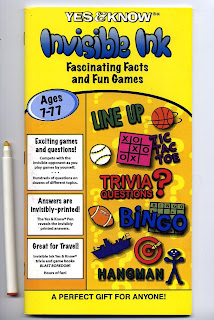
They still look and work the same today as when I was a kid, and I became intrigued: where did these books come from, anyway? I tracked them down to a 1974 patent by Leon Lenkoff of Louisville, Kentucky. (His company, Lee Publications, continues making Yes & Know to this day.) But what struck me was that he cited a 1968 patent by a "Burrhus Frederic Skinner."
B... F... Skinner?

Yep!
Skinner's invention was part of his interest in automating learning; a handwriting worksheet that turned red when drew outside the dotted lines would save teacher labor for more personalized tasks. It was Lenkoff's bright idea to take this idea of defined areas of invisible ink and apply them to tic-tac-toe, 20 Questions, and a Battleship knockoff called "Fleet."
Skinner himself notes an older patent by an Antioch College chemistry instructor for a self-correcting quiz (e.g. fill in the wrong bubble and it turns red, while the correct answer bubble turns green). Skinner was so fond of that idea that he patented an anti-cheating version.
It's a charmingly retro technology. But it turns out that cheatproof decoder pen idea is making a comeback in polling booths this year with a vote confirmation system called Scantegrity.

So all those games of Decoder Pen Baseball on the airplane and in the car? Training for secure voting...


They still look and work the same today as when I was a kid, and I became intrigued: where did these books come from, anyway? I tracked them down to a 1974 patent by Leon Lenkoff of Louisville, Kentucky. (His company, Lee Publications, continues making Yes & Know to this day.) But what struck me was that he cited a 1968 patent by a "Burrhus Frederic Skinner."
B... F... Skinner?

Yep!
Skinner's invention was part of his interest in automating learning; a handwriting worksheet that turned red when drew outside the dotted lines would save teacher labor for more personalized tasks. It was Lenkoff's bright idea to take this idea of defined areas of invisible ink and apply them to tic-tac-toe, 20 Questions, and a Battleship knockoff called "Fleet."
Skinner himself notes an older patent by an Antioch College chemistry instructor for a self-correcting quiz (e.g. fill in the wrong bubble and it turns red, while the correct answer bubble turns green). Skinner was so fond of that idea that he patented an anti-cheating version.
It's a charmingly retro technology. But it turns out that cheatproof decoder pen idea is making a comeback in polling booths this year with a vote confirmation system called Scantegrity.

So all those games of Decoder Pen Baseball on the airplane and in the car? Training for secure voting...

Saturday, November 19, 2005
Scrabble: The Anti-Drug
Nicholas Blincoe in today's Telegraph relates an amusing tale of Graham Greene:
Speaking of such things, while in Seattle I ran into Vinnie Wilhelm, a recent grad of the Writers' Workshop and one of my old Scrabble sparring partners. Vinnie's mulling a book idea that you will certainly be reading between hardcovers in a couple years or so -- it's pretty great -- but in the mean time, you'll just have to settle for his recent interview with Daniel Alarcon:
The playwright Michael Meyer travelled around the world with Greene in the 1950s. Greene had promised opium-smoking and other tropical decadences, so Meyer was disappointed to find that Greene had packed a portable Scrabble board. The nightly Scrabble games almost ruined their friendship. The problem, according to Meyer, was that Greene's spelling was "deeply dubious", and the pair did not have a dictionary. During a stay in Tahiti, Greene produced the words "zeb", which he claimed was an Elizabethan word for "cock", and "quoign" which he insisted was Shakespearean, quoting: "Yon castle's quoign that Duncan's spirit haunts."
Meyer thought the line was as dubious as Greene's spelling and, in the sultry Tahitian nights, tempers frayed. The pair were still arguing when they reached San Francisco, months later. They ran straight from the ship to a second-hand book store and found a dictionary. The word was in, spelled "quoin", which satisfied Greene, though as Meyer pointed out, "quoin" would not have landed on a triple letter score.
Speaking of such things, while in Seattle I ran into Vinnie Wilhelm, a recent grad of the Writers' Workshop and one of my old Scrabble sparring partners. Vinnie's mulling a book idea that you will certainly be reading between hardcovers in a couple years or so -- it's pretty great -- but in the mean time, you'll just have to settle for his recent interview with Daniel Alarcon:
Vinnie: I'd like to begin with oral sex. In "City of Clowns," the second story in your collection, you provide one of the most compelling instances in recent literature of a man performing cunnilingus on a woman who is wearing stilts. I think we'd all love to hear whatever you feel comfortable sharing about the genesis of this scene.
Daniel Alarcón: In Lima I briefly dated a girl who owned a pair of stilts. I can't really say much more about it, except to add that I write fiction and have an active imagination.
Sunday, July 10, 2005
NEA: GMAFB
Perhaps it was having too much time waiting in the -- god help us all -- Reagan National Airport yesterday, but I found myself jabbing at the Washington Post like a bird picking ticks off a rhino. Owners Closing The Book on Libraries in the Home, announced one scare headline. "When people walk into a modern home, they don't ask about a library," explained a researcher from the National Association of Home Builders.
Oh my -- no library. Higgins, fetch me my smelling salts!
How might one turn this minor architectural trend into a societal problem? Hmm. Oh, I know! Just cite.... wait for it... wait for it.... yes, you guessed it!....
In fact, separate space in a house specifically designated for reading "is fast becoming a rarity," said Mark Bauerlein, director of the Office of Research and Analysis of the National Endowment for the Arts, the government agency that last year documented a decline in book reading among Americans in a report titled "Reading At Risk: A Survey of Literary Reading in America."
That's right. The NEA, which apparently never met a cultural crisis it didn't like, is now worried that our homes lack libraries:
The shift away from home libraries is disconcerting to some, such as Bauerlein of the National Endowment for the Arts. Reading is "a high-concentration activity" that cannot easily take place while multi-tasking or in the presence of rooms with distractions such as e-mail, TV or computer games, he said. In addition, a home library typically houses many books, he said, and "the presence of books in a household has a deep effect on the habits, inclinations and intellectual development of people in that household."
Yes, quite so. There are other shifts from home planning that I too find disconcerting. Why is there no ice-house in my backyard? Where's my carriage house and servants' quarters? And why, pray tell, is my house not equipped with a coal room?
But wait: think of the most well-read person you know. Do they have a library in their house? Or are the books on shelves scattered throughout the dwelling, and perhaps also in a home office equipped with those nefarious telephonic and computing devices? Do they read in bed sometimes, or in front of their computer screen? Are they, perhaps, also fond of reading in one of those newfangled coffeehouses?
One final note. I spent the last couple days in the Houghton Library at Harvard, and then at the Library of Congress reading room and the Folger Shakespeare Library in DC. Each is the epitome of a serious library -- dark wood everywhere, a hushed atmosphere lit by stained glass windows, and little ladders reaching precariously up to ancient leatherbound folios. But, do you know, I saw patrons carrying cell phones and using... computers?
So I guess those aren't real libraries either... right, NEA?
Oh my -- no library. Higgins, fetch me my smelling salts!
How might one turn this minor architectural trend into a societal problem? Hmm. Oh, I know! Just cite.... wait for it... wait for it.... yes, you guessed it!....
In fact, separate space in a house specifically designated for reading "is fast becoming a rarity," said Mark Bauerlein, director of the Office of Research and Analysis of the National Endowment for the Arts, the government agency that last year documented a decline in book reading among Americans in a report titled "Reading At Risk: A Survey of Literary Reading in America."
That's right. The NEA, which apparently never met a cultural crisis it didn't like, is now worried that our homes lack libraries:
The shift away from home libraries is disconcerting to some, such as Bauerlein of the National Endowment for the Arts. Reading is "a high-concentration activity" that cannot easily take place while multi-tasking or in the presence of rooms with distractions such as e-mail, TV or computer games, he said. In addition, a home library typically houses many books, he said, and "the presence of books in a household has a deep effect on the habits, inclinations and intellectual development of people in that household."
Yes, quite so. There are other shifts from home planning that I too find disconcerting. Why is there no ice-house in my backyard? Where's my carriage house and servants' quarters? And why, pray tell, is my house not equipped with a coal room?
But wait: think of the most well-read person you know. Do they have a library in their house? Or are the books on shelves scattered throughout the dwelling, and perhaps also in a home office equipped with those nefarious telephonic and computing devices? Do they read in bed sometimes, or in front of their computer screen? Are they, perhaps, also fond of reading in one of those newfangled coffeehouses?
One final note. I spent the last couple days in the Houghton Library at Harvard, and then at the Library of Congress reading room and the Folger Shakespeare Library in DC. Each is the epitome of a serious library -- dark wood everywhere, a hushed atmosphere lit by stained glass windows, and little ladders reaching precariously up to ancient leatherbound folios. But, do you know, I saw patrons carrying cell phones and using... computers?
So I guess those aren't real libraries either... right, NEA?
Sunday, January 02, 2005
Lovey Dovey-Ovey All The Time
Now that the obligatory "Best of 2004" articles are the out the way, London papers are turning to a more interesting topic: what's coming in 2005. The Guardian weighs in with two articles; along with the usual nods to Updike, McEwan, and Ishiguro, there are some appealing oddballs listed.
Take At Day's Close: A History of Night-time by A Roger Ekirch ("A fascinating idea, exploring what went on at night between 1500 and 1830. Before gas and electric light rewired the glamour of darkness, night was a different thing altogether...") and Epileptic by French artist David B ("The author's visual account of his brother's struggle with epilepsy... The art style is strikingly beautiful, at times so heavily inked as to resemble occult woodcuts, and the decision to show the oppressive swarmings of serpents and other fantastical monsters as a visual metaphor for the illness is inspired. ")
I've blurbed Pantheon's US edition of Epileptic, and enthusiastically so. Parts have been previously published by the heroic Fantagraphics, but this new complete version is a must-have if you care about graphic narraritives, or books, or the human condition. So: Just. Go. Get. It.
Meanwhile, down the hallway at The Guardian, Stuart Jeffries cites a memoir that should warm the hearts of bookworms everywhere: "Julie Myerson's touching memoir Not a Games Person is about how hopeless she was at PE. " Julie, you are among friends now. But over at the Independent, there is a horrifying preview of the Atlantic title Divine Love:
Its authors, Sara Hulse and Toby Starbuck, "examine their own romance" to "embark upon a journey that is part wedding plan, part philosophical odyssey". If that makes you feel a little queasy, just read on. "About the authors: Sara and Toby recently abandoned their West Hampstead love nest for the Sussex countryside, regularly returning to the capital for work, sushi and fashionable clothing. When in town, Toby provides the scripts for movie trailers and Sara works at a literary agency."
Ah yes. Splendid. Please excuse me while I put out my eyes with a rusty thumbtack.
Take At Day's Close: A History of Night-time by A Roger Ekirch ("A fascinating idea, exploring what went on at night between 1500 and 1830. Before gas and electric light rewired the glamour of darkness, night was a different thing altogether...") and Epileptic by French artist David B ("The author's visual account of his brother's struggle with epilepsy... The art style is strikingly beautiful, at times so heavily inked as to resemble occult woodcuts, and the decision to show the oppressive swarmings of serpents and other fantastical monsters as a visual metaphor for the illness is inspired. ")
I've blurbed Pantheon's US edition of Epileptic, and enthusiastically so. Parts have been previously published by the heroic Fantagraphics, but this new complete version is a must-have if you care about graphic narraritives, or books, or the human condition. So: Just. Go. Get. It.
Meanwhile, down the hallway at The Guardian, Stuart Jeffries cites a memoir that should warm the hearts of bookworms everywhere: "Julie Myerson's touching memoir Not a Games Person is about how hopeless she was at PE. " Julie, you are among friends now. But over at the Independent, there is a horrifying preview of the Atlantic title Divine Love:
Its authors, Sara Hulse and Toby Starbuck, "examine their own romance" to "embark upon a journey that is part wedding plan, part philosophical odyssey". If that makes you feel a little queasy, just read on. "About the authors: Sara and Toby recently abandoned their West Hampstead love nest for the Sussex countryside, regularly returning to the capital for work, sushi and fashionable clothing. When in town, Toby provides the scripts for movie trailers and Sara works at a literary agency."
Ah yes. Splendid. Please excuse me while I put out my eyes with a rusty thumbtack.
